voynich
✎ EditVoynich Manuscript
https://www.voynichese.com/ WRONG EVA!! e.g. “shopchy” vs “shofchy”
../texts/voynich/voynich.unicode.pure.txt
https://www.kreativekorp.com/software/fonts/voynich/
Folio 49b (page 98) of the Voynich Manuscript contains Indo-Arabic numerals presumably annotating numbers:

Whether these annotations were contemporary and informed or later guesses, the repeating character sequences do hint at a true connection with numerals:
folio 57 back, line 3
versus
Folio 49b ≈ ≈ ☑ ( ᕐ ≈ ≈ ≈ ς ≈ 𝞻 ≈ ҁ ≈ 4 ! )
also see / first letter of odd / even months (article?)

The numbers on the ‘Astrolabe’ f57v are similar
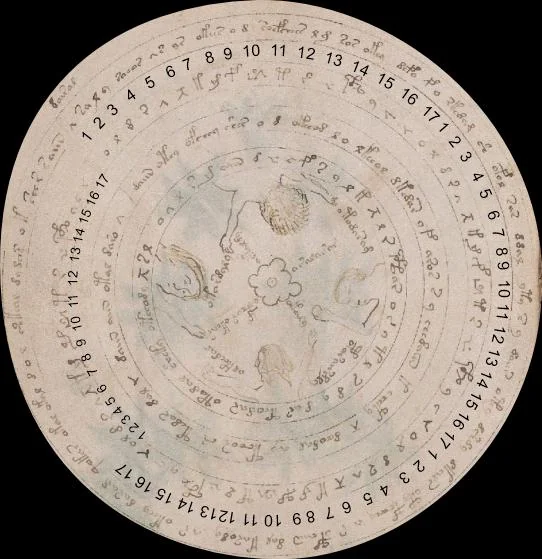
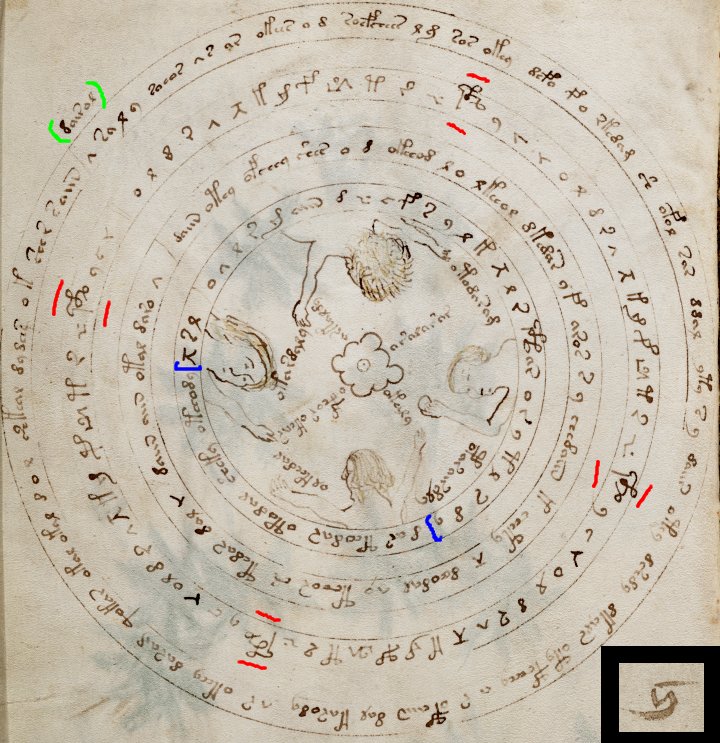
Interestingly numerals in the various derivatives of Brahmi scripts (in 5½ out of 7 cases) show a remarkable resemblance:
Voynich numbers folio 57:
1 ≈ EVA ‘o’ a / ein / π proto- prefix article - - - ( even vs for odd months)
2 ≈ EVA ‘r’
3 ≈ EVA ‘y’
4 ≈ EVA ‘c’ ‘e’ ‘h’ ⚡︎ ?
5 ≈ EVA ‘v’ 𓎆 ≈
6 ≈ EVA ‘k’ 6/7 ?
7 ≈ EVA ‘s’
• ≈ EVA ‘p’
Brahmi:
1 ≈ 𑇑 ౧ ၁ ᧑
2 ≈ २
3 ≈ ≈ ৩ ≈ ၃ ≠ ౨ 𑽒
4 ≈ ≈ ၄ ≈ ༤
5 ≈ 𓎆 ≈ 𑁖 ≈ ༥ II. ‘ᵓ’ ٥ @ arabic 𑁖 5 “pancha” ≈ 𐨤 “p” @ Kharosthi
6 ≈ ≈ ‘ꠉ’ ≈ ೬ ≈ 𑽖 ?
7 ≈ ౭
8 ≈ 0 ≈ P ?
While no extant Brahmi derived script matches the numerals perfectly, Myanmar with 4 out of 7 good matches comes closest:
Brahmi |Telugu | Myanmar| Other
————|——-|——–|—————
𑁒 ONE | ౧ | ၁ | 𑇑 Sharada, Kawi, ൧ ୧ ᧑ Tai Lue
𑁓 TWO | ౨ | ၂ | २ Devanagari
𑁔 THREE | ౩ | ၃ | ৩ Bengali
𑁕 FOUR | ౪ | ၄ | ༤ Tibetan S Bengali Burmese
𑁖 FIVE | ౫ | ၅ | 𑁖 Brahmi Bengali ৫ ≈ c Sindhi ५ Nepali-Marathi-Gurkhali
𑁗 SIX | ౬ | ၆ | ೬ Kannada early form! 300BC-700CE Andraha … Nepali 12th CE
𑁘 SEVEN | ౭ | ၇ | ౭
𑁙 EIGHT | ౮ | ၈ | @ Astrolabe
𑁚 NINE | ౯
𑁛 TEN
The Myanmar variant is especially interesting as it is close to Brahmi derived Tai Le script in Yunan, China.
Phags-pa, a very different Brahmi alphabet, was historically used during the Yuan dynasty for various languages, including Chinese. Similarly Marchen script is unlike Voynich script.
For more matches see Georges Ifrah “The Universal History of Numbers” p.368…
Even though ೬ is the best extant match for Voynich ‘6’, φ forms were widespread in the first millennium AD.
Note that the series does not repeat predictably after 5
The three series look like
P 1 2 3 4 5 6? 7?
P 1 2 3 4 5 6’?
P 1 2 3 4 5 X
“3 4 6? 3”
Six is the most problematic in this series, there is no (known) good approximation, in general the form might be closest to Brahmi signs for L.
ꠉ บ ⇔ ៦ ๖ ໖ ೬ ၆ ⇔ LO ល LY ឭ liao LLLA ഴ LA ல LA ల PLA ป LA ལ BUT ౫ = 5 !
The sign २ for 2 looking similar to 2 is no coincidence since European numerals are ultimately derived from Brahmi numerals: 𑁦 𑁧 𑁨 𑁩 𑁪 𑁫 𑁬 𑁭 𑁮 𑁯.
The representation of numbers using letters of derived Brahmi scripts was often used in various metrical compositions, which are poetic verses with specific rules for rhythm and syllabic count, especially during the classical period of Indian mathematics and astronomy (roughly from the 5th to the 12th century CE).
Just like Roman alphabets don’t reveal the underlying language, Brahmi derived signs are compatible with a wide swath of languages: All far eastern languages of countries that adopted Buddhism, e.g. :
౧ Telugu ⇨ Dravidian:Tamil,Telugu PIE:Pallava,Prakrit, Sanskrit!, Brahmic/Sharada
၁ Myanmar ⇨ Burma: Sino-Tibetan
In any case the letter frequency distribution of Voynich is typical for a real language written with an alphabet or an abjad, so while the numbers could be Brahmic, the full syllabary is certainly not used:

So other methods of linguistics need to be applied to make possible connections to language families:
Word length distribution hints at any tonal language such as:

or Chinese:

or other…
Tonal languages are further dictated by Character Entropy [0], the only plausible alternatives to Sino-Tibeto-Burman origins of the language (not the script!) being other tonal languages maybe in the Niger-Congo or Malayo-Polynesian families.


Min Dong and Hakka belong to the Sino-Tibetan language family, specifically to the Chinese branch. The study [0] did not include pinyin or wade-giles transliterations of Mandarin, Cantonese or other Chinese dialects, so ancestral forms of these could be good candidates too.
Statistics rule out substitution cyphers of any non-tonal language, as well as ‘random’ babbling since the script has structural features very typical of real languages, specifically typical word and letter frequency curves.
Cyphers which would break Zipfs law are also ruled out.
Word duplication or triplication is a puzzling feature of the Voynich script, but a grammatical feature of said languages especially if one makes the assumtion that tones are not represented in the transcription system. In fact there is an infamous 94 word long chinese poem in which every word is pronounced shi ([ʂɻ̩]) :
No one (including scholars at the Chinese Academy of Sciences in Beijing) has been able to find any clear examples of Asian symbolism or Asian science in the illustrations (except maybe for Lotus and Dragon) indicating that the document was produced in Europe after the return of the Marco Polo delegation.
However, the apparent division of the year into 360 days (rather than 365 days), in groups of 15 and starting with Pisces, are features of the Chinese agricultural calendar (jie qi, 節氣).
The Voynich script originated in the 15th century CE, about a century after the return of Marco Polo from China and the very successful publication of his Livre des Merveilles du Monde or Devisement du Monde (“Description of the World”). It is important that the text was composed in a European context though, as evidenced by much of the iconography.
Summary of Evidence:
EVERYTHING SEEMS OFF + OUT OF ORDER! (ok, reassembled wrongly, see numbers) ZODIAC
zodiacs with “third hand” latin annotations
Capricon the Goat and Aquarius the Water Bearer are missing from the VM set, and both Aries and Taurus appear twice, suggesting either that the series was left unfinished or that the other zodiac symbols were not directly relevant to the information surrounding the center symbols. 10 Month calendar??
The deeper question is whether the Voynich compiler was following computistical practice, an almanac tradition, or some regional month–sign association. That’s still debated.
Voynich list starts with “march” for reasons: the ecclesiastical year or Paschal tables begin with March. Easter computus is keyed to the March full moon after the equinox.
A useful continuation is to compare with non-Latin calendars (Hebrew, Syriac, Coptic) that start the year in March
Pisces ♓ mars March
Aries ♈ aberil April ≈ Codex Schürstab (Nürnberg) * 2
Taurus ♉ maŷ, May * 2
Gemini ♊ Yuny/Yony Juni, June
Cancer ♋ Iollio July (♋crayfish/lobsters ♋ not uncommon) ≈ Codex Schürstab
Leo ♌ Augst August
Virgo ♍ septembre (Greek miniscules vowels) + Spica
Libra ♎ Libre, Libra, October, Octobris, Octembre
Scorpius ♏ Scorpronis, Scorpio, November, Novembris, Novembre 🐻🐉 lizards wth;) not uncommon
Sagittarius ♐ northern Europe style with legs and crossbow (never saw scorpions;) Schürstab/Israel
Capricorn ♑ ≈♈? ⚠️ see Aries but noted as aberil twice!
Aquarius ♒ ≈♉ 牛 niú! wrongly noted as may/maŷ twice by “third author”
Pisces ♓ Piscium, Pisces, Mars, March ≈ du Berry Book of Hours VERY similar! ≈ Codex Schürstab (Nürnberg)
Explanations for the strange scorpion, “double” Aries and Taurus:
• Capricorn looks very much like Aries
• Scorpio can be explained as escalating bad copy of 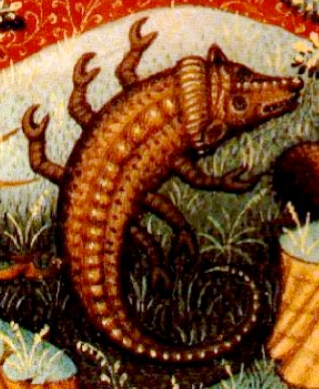
• “Scorpio” green lizard can be explained as cyan Azure Dragon 青龍 Qīnglóng ⇔ 心宿 Xīn Xiù
• Second “Taurus” 牛 (niú „Ochse/Kuh“) can be explained by author as mismatch between Capricornus und Aquarius! vs Turtle 玄武 Xuánwǔ
curved garland linking their mouths => 13,14 ?
https://voynichportal.com/2013/07/27/the-voynich-zodiacs/
ZODIACS: ♈goat ♓pisces ♈goat ♉oxus ♉oxus ♊gemini ♋cancer(lobsters) ♎libra virgo ♌leo ♏ursa+pole ♐archer
European’ish zodiacs in https://www.voynichese.com/#/f70v1 …
European’ish symbolism with some middle eastern elements
Voynich vocabulary follows Zipfs law
Voynich character distribution typical for real languages
Voynich character entropy only compatible with tonal languages, as
Many classes of cyphers are ruled out
Two dialects, five hands
Brahmi numerals / numbers
Chinese calendar ( 360 = 2 * 12 * 15 or 72 * 5 = 18 * 20 )
Numerals coincide with letters, similar to Greek and Sanskrit ancestors.
The authors …
were generally inserted in the European culture.
had seen typical medieval herbals and astrological writings, and imitated that style.
had good handwriting,
had limited artistic abilities (the quality of drawings clearly improved as he worked on the VMS).
had practically no geometric sensibility or education.
did not give much tought to layout (bent and tilted lines, uneven line spacing, crooked template-drawn circles, overlapping and overflowing diagrams, etc. etc.)
worked at the VMS for many months, perhaps several years.
Topics and hands
Two languages/dialects 4-5 hands

Topics are correlated with the different ‘hands’:

Topics cluster with specific words:

Most frequent words by topic (using standard EVA transcription, NOT to be read phonetically):
Topic 0: chedy daiin shedy ol aiin chol or ar gokeedy gokedy gokain chey gokeey gokaiin shey al dar chor dal okaiin
Topic 1: daiin chol chor thy chy shol sho cthol cthor shor shy cho dy chaiin dain gotchy otchy cheor dor they
Topic 2: aiin ar al or okar air otaiin oteos oteey okaiin otar oteody okal cheody chdy otal am dar ykar okey
Topic 3: okeol cheol gokeey gokeol okey cheor cheey shey sheol ckhey cheody ol cheo oteey okey gokeody okol gokeedy chey dol
Topic 4: gokaiin al gokain gokeedy otaiin ar gokeey lkaiin chey gotaiin oteey lchedy chol chy raiin lkeey gotain chaiin otain
Topic 5: okaiin or gokain ol gokar chol gokaiin okar okaiin goal godaiin gokol otain okain okal chdy kaiin olkain gotaiin okol gokeo
Topic 0,1: most ‘European’ gok(e) prefix Topic 2: Completely different language or key!? al… aiin ok-aiin ot-aiin oteos oteey Topic 3,4,5: Completely different language or key!?
Chinese phonology has a very limited set of consonants at the end of words, mostly n and g, rarely r and in Cantonese some exceptions. Words starting with consonants are mostly of the form a- wu- /u/ yi- /í/. This motivates a very preliminary incomplete mapping:
Map dy⇨ng d⇨ń l⇨ƞ o⇨í/yi go⇨yi’
Topic 0: cheng ńaiin sheng íƞ aiin chíƞ ír ar yi-keeng yi-keng yi-kain chey yi-keey yi-kaiin shey aƞ ńar chír ńaƞ íkaiin
Topic 1: ńaiin chíƞ chír thy chy shíƞ shí cthíƞ cthír shír shy chí ng chaiin ńain yi-tchy ítchy cheír ńír they
Topic 2: aiin ar aƞ ír íkar air ítaiin íteís íteey íkaiin ítar íteíng íkaƞ cheíng chng ítaƞ am ńar ykar íkey
Topic 3: íkeíƞ cheíƞ yi-keey yi-keíƞ íkey cheír cheey shey sheíƞ ckhey cheíng íƞ cheí íteey íkey yi-keíng íkíƞ yi-keeng chey ńíƞ
Topic 4: yi-kaiin aƞ yi-kain yi-keeng ítaiin ar yi-keey ƞkaiin chey yi-taiin íteey ƞcheng chíƞ chy raiin ƞkeey yi-tain chaiin ítain
Topic 5: íkaiin ír yi-kain íƞ yi-kar chíƞ yi-kaiin íkar íkaiin yi-aƞ yi-ńaiin yi-kíƞ ítain íkain íkaƞ chng kaiin íƞkain yi-taiin íkíƞ yi-keí
At this stage ń,ƞ,n do not represent definitive sounds but are rather used to distinguish characters in the domain of the map.
Speculative phonology of some numbers is consistent with above mapping:
1 ≈ ‘o’ ౧ ၁ ⇔ 𓂂 ain yin ≈ yi
2 ≈ २ ‘r’
3 ≈ ‘9’ ≈ ၃ ?
4 ≈ ‘ˢ’ ‘ᶜ’ ⇔ ၄ ༤ ‘ci’ / ‘si’ vs 𑁕 𑁪 ૪ ੪ ৪ 𑀫 MU 𔖻 𔑿 mi mu 𔗘 𒐼 le’mu 𒇹
5 ≈ ‘𓎆’ ≈ 𑁖 ≈ ༥ II. ᵓ ٥ @ arabic ⇔ ه/و hu/wu ?
6 ≈ ꠉ บ ೬ ⇔ ៦ ๖ ໖ ၆ LO ល LY ឭ liao LLLA ഴ LA ல LA ల PLA ป LA ལ BUT ౫ = 5 !
7 ≈ ౭ = ౭ si? qi?
8 ⇔ 0 ? P? pa 𐋨 ba ?
Comparing the EVA readings to modern Chinese:
1 ≈ EVA ‘o’ yi •ain
2 ≈ EVA ‘R’ er (12 in folio 57 / ⚠️ 4 in folio 57 ) wrong guess by later annotator?
3 ≈ EVA ‘y’ san ⚠️ σ ‘ng’ in -dy
4 ≈ EVA ‘c’ si ‘e’ ‘h’
5 ≈ EVA ‘v’ wu
6 ≈ EVA ‘k’ liao ⚠️
7 ≈ EVA ‘s’ qi
8 ≈ EVA ‘p’ ba
folio 57 back has an extra sign/number between and :
| Brahmi | Telugu | Myanmar | Other |
|---|---|---|---|
| 𑁒 ONE | ౧ | ၁ | 𑇑 Sharada, Kawi, ൧ ୧ ᧑ Tai Lue |
| 𑁓 TWO | ౨ | ၂ | २ Devanagari |
| 𑁔 THREE | ౩ | ၃ | ৩ Bengali |
| 𑁕 FOUR | ౪ | ၄ | ༤ Tibetan S Bengali Burmese |
1 ≈ EVA ‘o’ yi ain ౧ ၁ 𑇑 ☑ 2 ≈ EVA ‘l’ ≈ er ≈ 两 liang 𓍼 ≈2 mirrored 3 ≈ EVA ‘d’ ≈ drei ౩ dʰan ≈ san ≈ ≈ 3 mirrored 4 ≈ EVA ‘r’ ᵛr vier <> ‘si’ ၄ 5 ≈ EVA ‘v’ wu 𝍮 𝍯 6 ≈ EVA ‘x’ ˢx six ≈ 六 liù ≠ ≈ 1+5 / 5+1 (Papuan languages, Austronesian, Mayan lima + sa ) 7 ≈ EVA ‘k’ ≈ qiᵇ 8 ≈ EVA ‘m’ 八 𓏠 𓈖 𓃒 ᵇаңмең V101 ‘p’ ≈ ba 9 ≈ EVA ‘f’ pʰsi ψ 𓊪 𓋴 𓆓 ≈ // 10 ≈ (2×5 L· decimal di·quim 10 only in Amazonian Australian Papuan languages, Sino-Tibetan ⍿ > ⟊ ); 11 ≈ ≈ 11 12 ≈ ≈ 2² ⚠️ ≈ 4 13 ≈ ⚡︎
Niger-Congo languages are tonal and have 6 = 1+5
5 out of 8 EVA mappings match the expected phonology reasonably well!
Note that we don’t know which Sino-Tibetan dialect exactly is represented, nor do we know with 100% certainty the phonology of reconstructed Chinese dialects, thus ‘reasonably well’ in this context is the best we can hope for.
double decans? 2 4 6 8 10 12 14 16 18 20 22 ( ≈ 𓎆 10 score)
If there is any reason in thes mapping it frees the EVA l
Note that a reading of ‘’ as í / yi was already dictated by the phone frequencies of Chinese!
Note that a reading of ‘’ as ‘c’ is cheating since it only occurs in compound signs!
The following reading is especially problematic
3 ≈ EVA ‘y’ san ⚠️ because it almost certainly has to map to word final ‘g’ ( ‘ng’ in -dy )
Maybe it is a tone marker?
https://www.voynichese.com/#/f9v/exa:dy/0
A similar very tentative mapping yields these most frequent words:
‘qíkiŋ’: 132, ‘ítuiŋ’: 133, ‘chng’: 137, ‘íkain’: 137, ‘µbu’: 140, ‘chøíïⁿ’: 144, ‘qíkar’: 144, ‘ain’: 145, ‘íten’: 152, ‘chuiŋ’: 152, ‘ítøng’: 153, ‘mí’: 162, ‘íkuiŋ’: 173, ‘qíkaïⁿ’: 184, ‘ḫaïⁿ’: 187, ‘ng’: 188, ‘ḫain’: 195, ‘chír’: 196, ‘muiŋ’: 196, ‘iŋ’: 204, ‘íken’: 211, ‘míïⁿ’: 218, ‘aïⁿ’: 226, ‘miŋ’: 253, ‘qíken’: 264, ‘qíkøng’: 270, ‘ḫar’: 276, ‘qíkain’: 276, ‘chøiŋ’: 298, ‘qíkung’: 301, ‘qíkuiŋ’: 302, ‘ír’: 320, ‘chíïⁿ’: 335, ‘ar’: 347, ‘møiŋ’: 427, ‘íïⁿ’: 433, ‘chøng’: 451, ‘en’: 472, ‘møng’: 652, ‘ḫen’: 786, ‘不’: 4301}
d⇨ń poses a problem for the most frequent word, which would be ḫen under d⇨ḫ or ńan/nam under d⇨ń.
The long tail is especially interesting since long words show combinations similar to qíngkøiŋ, miŋ’ckhíï …
Since ch has ligatures with P, t, k and f and is predominantly found at words starts, it’s likely that ch denotes aspiration pʰ tʰ kʰ fʰ (bʰ?).
As noted by Bowern [1], chedy and shedy (cheng/sheng) should be variants of the same word in order to match the zipf distribution, which seems very plausible and may hint at a lack of expertise on side of the original scribe when writing down what he heard.
This is certainly not the final word but should encourage further research. In fact, in order to not introduce bias into further research, a full mapping is intentionally not provided here.
References and recommended further reading:
[0] Luke Lindemann, Claire Bowern : Character Entropy in Modern and Historical Texts https://arxiv.org/abs/2010.14697 May 20, 2021
[1] Claire L. Bowern and Luke Lindemann: The Linguistics of the Voynich Manuscript
https://www.annualreviews.org/doi/pdf/10.1146/annurev-linguistics-011619-030613 November 11, 2020
[2] Rachel Sterneck, Annie Polish, Claire Bowern: Topic Modeling in the Voynich Manuscript https://arxiv.org/abs/2107.02858
[3] Cardan grille https://www.reddit.com/r/voynich/comments/oyeayi/a_cipher_wheel_inspired_by_rene_zandbergens_paper/
[4] 360 degrees https://www.reddit.com/r/voynich/comments/dd4zj2/zodiac_and_moirogenesis_paranatellonta/
[5] General Observations https://www.reddit.com/r/voynich/comments/mt18bu/some_general_observations/
[6] Stolfi’s Chinese Voynich hypothesis https://www.ic.unicamp.br/∼stolfi/voynich/02-01-18-chinese-redux/
[7] Chinese investigated: https://web.archive.org/web/20180928122339/http://graphometrie.free.fr/publications/Voynich_en.pdf
Theory: Some member(s) of the Marco Polo delegation tried to teach some Chinese dialect to European scholars and convey some of the knowledge gathered on the journey. Thus the voynich script may represent a scientific and linguistic chapter of Devisement du Monde which was either published separately or dropped from later copies for obvious reasons.
Further reading and updated information at https://github.com/pannous/hieros/wiki/voynich
Noteworthy
okeo in same position on moon chart https://www.voynichese.com/#/f68r2/exa:okeo/751
private font
https://www.kreativekorp.com/software/fonts/voynich/
Unicode Private Use Area (PUA) codepoint, never to be standardized:
50 800 U+0FF400
50 800 U+0FF401
50 800 U+0FF402
50 800 U+0FF403
50 800 U+0FF404
50 800 U+0FF405
50 800 U+0FF406
50 800 U+0FF407
50 800 U+0FF408
50 800 U+0FF409
50 800 U+0FF40A
50 800 U+0FF40B
50 800 U+0FF40C
50 800 U+0FF40D
50 800 U+0FF40E
50 800 U+0FF40F
50 800 U+0FF410
50 800 U+0FF411
50 800 U+0FF412
50 800 U+0FF413
50 800 U+0FF414
50 800 U+0FF415
50 800 U+0FF416
50 800 U+0FF417
50 800 U+0FF418
50 800 U+0FF419
50 800 U+0FF41A
50 800 U+0FF41B
50 800 U+0FF41C
50 800 U+0FF41D
50 800 U+0FF41E
50 800 U+0FF41F
50 800 U+0FF420
50 800 U+0FF421
50 800 U+0FF422
50 800 U+0FF423
50 800 U+0FF424
50 800 U+0FF425
50 800 U+0FF426
50 800 U+0FF427
50 800 U+0FF428
50 800 U+0FF429
50 800 U+0FF42A
50 800 U+0FF42B
50 800 U+0FF42C
50 800 U+0FF42D
50 800 U+0FF42E
50 800 U+0FF42F
50 800 U+0FF430
50 800 U+0FF431
50 800 U+0FF432
50 800 U+0FF433
50 800 U+0FF434
50 800 U+0FF435
50 800 U+0FF436
50 800 U+0FF437
50 800 U+0FF438
50 800 U+0FF439
50 800 U+0FF43A
50 800 U+0FF43B
50 800 U+0FF43C
50 800 U+0FF43D
50 800 U+0FF43E
50 800 U+0FF43F
50 800 U+0FF440
50 800 U+0FF441
50 800 U+0FF442
50 800 U+0FF443
50 800 U+0FF444
50 800 U+0FF445
50 800 U+0FF446
50 800 U+0FF447
50 800 U+0FF448
50 800 U+0FF449
50 800 U+0FF44A
50 800 U+0FF44B
50 800 U+0FF44C
50 800 U+0FF44D
50 800 U+0FF44E
50 800 U+0FF44F
50 800 U+0FF450
50 800 U+0FF451
50 800 U+0FF452
50 800 U+0FF453
50 800 U+0FF454
50 800 U+0FF455
50 800 U+0FF456
50 800 U+0FF457
50 800 U+0FF458
50 800 U+0FF459
50 800 U+0FF45A
50 800 U+0FF45B
50 800 U+0FF45C
50 800 U+0FF45D
50 800 U+0FF45E
50 800 U+0FF45F
50 800 U+0FF460
50 800 U+0FF461
50 800 U+0FF462
50 800 U+0FF463
50 800 U+0FF464
50 800 U+0FF465
50 800 U+0FF466
50 800 U+0FF467
50 800 U+0FF468
50 800 U+0FF469
50 800 U+0FF46A
50 800 U+0FF46B
50 800 U+0FF46C
50 800 U+0FF46D
50 800 U+0FF46E
50 800 U+0FF46F
50 800 U+0FF470
50 800 U+0FF471
50 800 U+0FF472
50 800 U+0FF473
50 800 U+0FF474
50 800 U+0FF475
50 800 U+0FF476
50 800 U+0FF477
50 800 U+0FF478
50 800 U+0FF479
50 800 U+0FF47A
50 800 U+0FF47B
50 800 U+0FF47C
50 800 U+0FF47D
50 800 U+0FF47E
50 800 U+0FF47F
50 800 U+0FF480
50 800 U+0FF481
50 800 U+0FF482
50 800 U+0FF483
50 800 U+0FF484
50 800 U+0FF485
50 800 U+0FF486
50 800 U+0FF487
50 800 U+0FF488
50 800 U+0FF489
50 800 U+0FF48A
50 800 U+0FF48B
50 800 U+0FF48C
50 800 U+0FF48D
50 800 U+0FF48E
50 800 U+0FF48F
50 800 U+0FF490
50 800 U+0FF491
50 800 U+0FF492
50 800 U+0FF493
50 800 U+0FF494
50 800 U+0FF495
50 800 U+0FF496
50 800 U+0FF497
50 800 U+0FF498
50 800 U+0FF499
50 800 U+0FF49A
50 800 U+0FF49B
50 800 U+0FF49C
50 800 U+0FF49D
50 800 U+0FF49E
50 800 U+0FF49F
50 800 U+0FF4A0
50 800 U+0FF4A1
50 800 U+0FF4A2
50 800 U+0FF4A3
50 800 U+0FF4A4
50 800 U+0FF4A5
50 800 U+0FF4A6
50 800 U+0FF4A7
50 800 U+0FF4A8
50 800 U+0FF4A9
50 800 U+0FF4AA
50 800 U+0FF4AB
50 800 U+0FF4AC
50 800 U+0FF4AD
50 800 U+0FF4AE
50 800 U+0FF4AF
50 800 U+0FF4B0
50 800 U+0FF4B1
50 800 U+0FF4B2
50 800 U+0FF4B3
50 800 U+0FF4B4
50 800 U+0FF4B5
50 800 U+0FF4B6
50 800 U+0FF4B7
50 800 U+0FF4B8
50 800 U+0FF4B9
50 800 U+0FF4BA
50 800 U+0FF4BB
50 800 U+0FF4BC
50 800 U+0FF4BD
50 800 U+0FF4BE
50 800 U+0FF4BF
50 800 U+0FF4C0
50 800 U+0FF4C1
50 800 U+0FF4C2
50 800 U+0FF4C3
50 800 U+0FF4C4
50 800 U+0FF4C5
50 800 U+0FF4C6
50 800 U+0FF4C7
50 800 U+0FF4C8
50 800 U+0FF4C9
50 800 U+0FF4CA
50 800 U+0FF4CB
50 800 U+0FF4CC
50 800 U+0FF4CD
50 800 U+0FF4CE
50 800 U+0FF4CF
50 800 U+0FF4D0
50 800 U+0FF4D1
50 800 U+0FF4D2
50 800 U+0FF4D3
50 800 U+0FF4D4
50 800 U+0FF4D5
50 800 U+0FF4D6
50 800 U+0FF4D7
50 800 U+0FF4D8
50 800 U+0FF4D9
50 800 U+0FF4DA
50 800 U+0FF4DB
50 800 U+0FF4DC
50 800 U+0FF4DD
50 800 U+0FF4DE
50 800 U+0FF4DF
50 800 U+0FF4E0
50 800 U+0FF4E1
50 800 U+0FF4E2
50 800 U+0FF4E3
50 800 U+0FF4E4
50 800 U+0FF4E5
50 800 U+0FF4E6
50 800 U+0FF4E7
50 800 U+0FF4E8
50 800 U+0FF4E9
50 800 U+0FF4EA
50 800 U+0FF4EB
50 800 U+0FF4EC
50 800 U+0FF4ED
50 800 U+0FF4EE
50 800 U+0FF4EF
50 800 U+0FF4F0
50 800 U+0FF4F1
50 800 U+0FF4F2
50 800 U+0FF4F3
50 800 U+0FF4F4
50 800 U+0FF4F5
50 800 U+0FF4F6
50 800 U+0FF4F7
50 800 U+0FF4F8
50 800 U+0FF4F9
50 800 U+0FF4FA
50 800 U+0FF4FB
50 800 U+0FF4FC
50 800 U+0FF4FD
50 800 U+0FF4FE
50 800 U+0FF4FF
50 800 U+0FF500
50 800 U+0FF501
50 800 U+0FF502
50 800 U+0FF503
50 800 U+0FF504
50 800 U+0FF505
50 800 U+0FF506
50 800 U+0FF507
50 800 U+0FF508
50 800 U+0FF509
50 800 U+0FF50A
50 800 U+0FF50B
50 800 U+0FF50C
50 800 U+0FF50D
50 800 U+0FF50E
50 800 U+0FF50F
50 800 U+0FF510
50 800 U+0FF511
50 800 U+0FF512
50 800 U+0FF513
50 800 U+0FF514
50 800 U+0FF515
50 800 U+0FF516
50 800 U+0FF517
50 800 U+0FF518
50 800 U+0FF519
50 800 U+0FF51A
50 800 U+0FF51B
50 800 U+0FF51C
50 800 U+0FF51D
50 800 U+0FF51E
50 800 U+0FF51F
Strike-through ligature forms:
:
:
:
:
:
:
:
looks more like 𐋁 𐙪 Ⴟ ≈ 𓍳 𓍲 𐠦 ɡ @ Berber šʳ < tṛ́ 𐙞 𓍶 #šn < turn
3 O 4 P 5 Q 6 R 7 S 8 T
Astrolabe numerals numbers f57v
≈ al- prefix? ≈ αη
Α Β Γ Δ Ε Ϝ Ζ Η Θ Ι Κ Λ
α β ζγ δ ε ϝφ γζ η ι θ κ λ μ νξ οω πφ ξ ϱ ςσ ψ τ θ υ φ ω χ υ ζ ϊ ϋ ό ύ ώ ϐ
α β γ δ ε (ϝ) ζ η θ ι κ λ μ ν ξ ο π ρ σ τ υ φ χ ψ ω
α a 0 / 1 EVA o(82) vs
β b 1 / 2 EVA l(58) 𐠦 𐋁 𓍲 vs vs 4 in contemporary latin
γ c 2 / 3 EVA d(51) 𓎝 𓎛
δ d 3 / 4 EVA r(98) ≈ 12
ε e 4 / 5 EVA v(7) vs 7 in contemporary latin
ζ f 5 / 6 EVA x(9) ≠ 𐀺 ᵍwoʳ
η g 6 / 7 EVA k(13)
ι h 7 / 8 / EVA m(11) ⚠️ ≠ k ≈
θ i 8 / 9 // p(5)/f(8)/? 𓊪𓋴𓆓
κ j 9 /10/11 EVA @169;v (2×5 L×) ! @169; is just the ‘L’ part
λ l 10/11/12 EVA t(8) (11 2ˣ1) L because of ≈ al- prefix
μ m 11/12/13 EVA ? ⚠️ ≆ 4 r(98) ≆ 7 ≠ ⚠️
ν n 12/13/14 EVA @170
ξ x! 13/14,15 EVA @171 + + ligature? ⇔ ♑ <> EVA i j m n YHWH?
ω o 14/15/16 EVA y(151) vs ≈ ≈ αη il/el/al/ul/yl ω≈w
χ ? 15/16/17 / EVA c(7) ≈ h
? ? 16/17/18 / EVA @172 ⇔ ? vs ≠ ‘r’
absent : π ρ σ τ υ φ χ ψ ω π≈β≈φ ρ≈λ σ≈ζ τ≈δ ω≈υ≈o χ ψ unused: κ! ξ ≈ + + i.k.s ≈ x ?
absent : letters via joined ligature ≈ + +
absent : 17 ≈ EVA q?
absent : 12 ≈ EVA s?
absent : EVA ‘s’ only in other system occupying / between and //
17 may show up in schemes such as in In 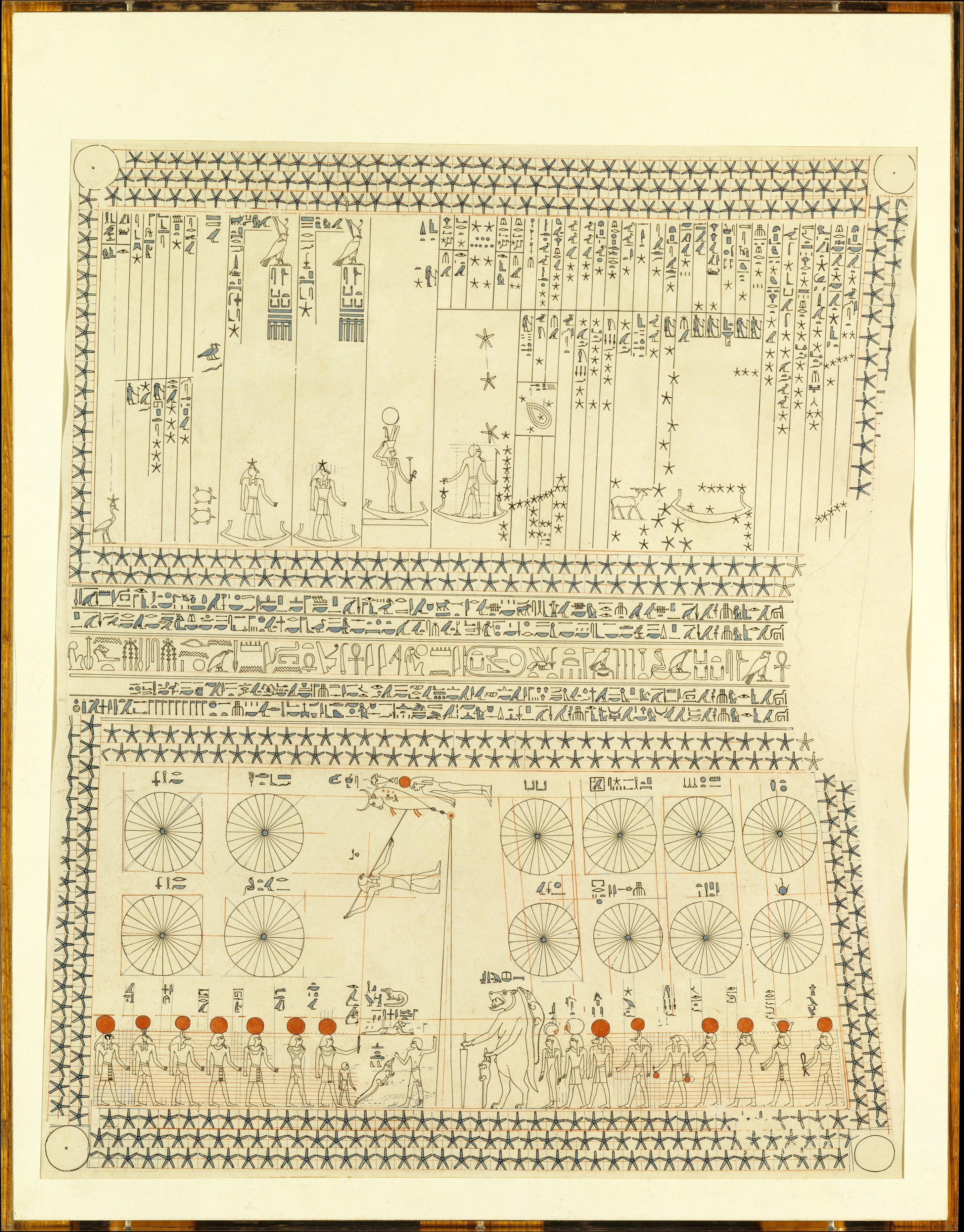 Astronomical_ceiling
365 = 12 “months” à 24 days + 5 extra days BETWEEN MONTHS + 17 see half-decans
was in fact + ≈ + joined by (later added) so the absent characters are now ALL explained!
why the strange ‘ligature’? ‘cipher’ or other ‘reason’
AGAINST the 17⇨18 un-merger theory is this wheel with 17 entries:
https://www.voynichese.com/#/f67v1/exa:sotey/720.5999755859375 ( 0 ≈ ø as hidden number?)
But the sun does have 18 spokes!
4 × 18 = 72 now makes sense as 72 x 5° = 360° 𓎆 ≈ dayn in 𓂋𓎆𓎆𓎆 = 1/30 = one day
72 is very remeniscent of syllabaries with (1+5)×12 = 60 + (12 consonants × 5 vowels + ø) see Elamite and Linear-B
72 “names” or “spirits” rooted in Jewish and Hermetic numerology: 72 angels, 72 demons (Ars Goetia compiled in the mid-17th century from materials several centuries older), 72 divine names (Kabbalah, 72 three-letter combinations ), each associated with a 5° arc.
Christian-Hermetic dimension: the 72 disciples sent out by Christ (Luke 10:1)
36 × 10° decans => 18 × 20 (4×5) double/semi decans “scores”
To overcome the problems posed by the doctrine of God’s transcendence, the early Jewish mystics developed an emanation theory in which the alphabet played an important part. They taught that the universe was divided into ten angelic spheres, each one governed by an intermediary or emanation of the divine.
The 72-fold name is highly important to Sefer Raziel HaMalakh. It is derived from Exodus 14:19–21, read boustrophedonically to produce 72 names of three letters. This method was explained by Rashi, as well as in Sefer HaBahir (c. 1150∼1200). Kabbalist legends state that the 72-fold name was used by Moses to cross the Red Sea, and that it could grant later holy men the power to cast out demons, heal the sick, prevent natural disasters, and even kill enemies.
72 hou (候), seasonal subdivisions of the year, but these are temporal (days) rather than angular.
72 hou = 3 × 24 节气 jiéqì not 4 × 18 :( 七十二候 shichijūni kō phenological
•In Greek astronomical texts, 72 is linked to the precession of the equinoxes (≈ 1° every 72 years, known from Hipparchus onward). This was treated numerically, not as a partition of the zodiac.
18 one less then 19-year Metonic cycle. triple ligature 14,15,16? 17 18 19?
mariner’s astrolabe or a nocturnal.
https://ciphermysteries.com/2010/07/01/astrolabes-nocturnals-and-voynich-manuscript-page-f57v
𓇳 Ra Sun in center “only came into use around 1480” ƒ => “Polaris” ƒ
Medieval scholars (e.g. Ramon Llull, d. 1316) used rotating wheels with alphabets to generate combinatorial sequences of divine attributes. Those wheels often had 16, 18, or 20 divisions. f57v has the exact “Llullian look”. 
 Starting with “B” though:
A = 𓇳 (center) / T Theos terminal? 9 x 2 /
B bonum
C magnum
D durans
E potens
F sapiens
G volens
H virtus
I verum
K gloria /
L perfect
M just
N larg-
O miser
P humil-
Q domino-
R patient
2 × 18
The sky was divided into 36 star groups (sbꜣw), each rising at 10-day intervals, used to mark night hours. This forms a numbering system of 36 repeating units.
Latin numbers: ≈ 𐠦 = 4 vs 2 ≈ 7 vs 5
Overlap with other numbers:
1 ≈ EVA ‘o’ 𓇳 ✅
2 ≈ EVA ‘r’ 𓆄 ≈ 12
3 ≠ EVA ‘y’ 𓏘
4 ≠ EVA ‘c’ ‘e’ ‘h’ ?
5 ≈ 𓎆 EVA ‘v’ 𓏏 𓇯 ✅
6 ≠ EVA ‘k’ 𓊨𓁹
7 ≠ EVA ‘s’ 𓊨𓏏
8 ≈ EVA ‘p’ ✅
9 // 𓊪 𓋴 𓆓 𓉠 ‘new’
ain as first letter of alphabet! abc abjad? #abcdef?
folio 48 back, line 3 abçeᵈo gad o geᵈaco abgeᵈeeo çaco çeco cabo ageead aiin alad aid ah
1 α 𓇳 ᵖraᵗ protoˢ proˢ ᵠerst ⲟⲩⲁ! ᚠ fu first בראשית be’reshid πraš
2 β 𓆄 shuᵇ shubat ≈ zweit / zwein > •shuni 𒁹𒁹 šina שניים …
3 Γ 𓏘 qu кхоъ qoʾ 𓏘 CIRᶥ ≈ 𓈎 TARᶥ third
4 Δ 𓅭 duck ≈ 𒌉 DUMU ≈ 𓅬 ордек ᶠordek fourth
5 Ε 𓏌𓏏𓇯 ether < 𐌀𐌉𐌈𐌕𐌓𐌀 < 𓊪 𓏏 𓇯 pẽta® < penta !? ⇔ Ea
6 Ϛ 𓊨𓁹 sees < Osiris ≈ Aššur 𒐀𒐼 6060 𒀭𒊹
7 Ζ 𓊨𓏏 ṣet < Astate ? Isis™
8 Η 𓃫 ‘chaot
9 Θ 𓉠 Nephthys ≈ Nun-phthys 𐦊 𓊪 𓋴 𓆓 ?
Inner circle ABC?:
(preamble) 672 section :
a b c d e ef! g h i j k l m n o p q r es t u v w x y z + Ψ
𓎆
1 5 2 4 8 aiin 3 13 16? 9 s 15 2
ain, pent, zwei, tetra, eight, 14
0 1 2 4 8 16

≈ θ ≈ 𐌚 in 𐌚𐌀𐌌𐌄𐌋 θameliā family < Dämel
18 letter alphabet?
Irish Ogham
Icelandic Futhark 16 runes, variants later expanded to 18–19
ᚠ ᚢ ᚦ ᚨ ᚱ ᚲ ᚷ [ᚹ] ᚺ ᚾ ᛁ ᛃ ᛈ ᛇ ᛉ ᛊ ᛏ ᛒ ᛖ ᛗ ᛚ ᛜ ᛞ ᛟ (24+1)
ᚠ F al’Pha ≈ fehu ᚠ first proto ain as first letter of alphabet!
ᚢ U < Veta < Beta bi 2
ᚦ T 3rd letter of al FaVeT < al’Phabet
ᚨ ᚱ H Hark / Hargam
ᚲ K Quint
ᚷ G
ᚺ
ᚹ
ᚾ naud ‘need’ ≈ nine
ᛁ 10
ᛃ 5+5 6+6
ᛈ
ᛇ
/
/
Maltese medieval scripts had ≈18 signs!
Hawaiian alphabet (1800ƒƒƒ) Polynesian languages often hover around 17–18 symbols
8 / 12 / 30
𒀭 on https://www.voynichese.com/#f67r2 (the “star map” with Pleiades-like clusters), stars are arranged in sevens, nines, and twelves. If f57v’s 72 is linked to those, the whole manuscript could be a compendium of “cosmic cycles” rather than one technical tradition. That is: f57v shows the abstract cycle; the zodiac folios show the applied version.
folio 57 back, line 1
folio 57 back, line 2 [?:] [:] ,, ,,, ,,, ,,,,,,,, , , ,,, ,[?:] ,
folio 57 back, line 3
folio 57 back, line 4 [:] {}
folio 57 back, line 5 [:] [:] , [:?] [:] [:]
folio 57 back, line 6 [:]
folio 57 back, line 7
folio 57 back, line 8
folio 57 back, line 9
folio 57 back, line 10 [:]
folio 57 back, line 11 ?
folio 57 back, line 12
folio 57 back, line 13 ,
Character explained(?) protoˢ … : : :
folio 75 back, line 1 {}
folio 75 back, line 2
folio 75 back, line 3 ,
folio 75 back, line 4
folio 75 back, line 5
folio 75 back, line 6
folio 75 back, line 7
folio 75 back, line 8
folio 75 back, line 9
folio 75 back, line 10 , ,
folio 75 back, line 11
folio 75 back, line 12 ,
Numbers reoccuring in
6 Segment circle
(⇨ ? )
6/9 Segment circle (hypo: 𓀡) 9 o’clock = level
Numbers reoccuring as ‘line numbers’ / Musical Keys?
https://www.voynichese.com/#/f66r/315 folio 66 front, line 16 …
⚠️ out-of-sequence! scholastic Bibles and civil-law codices provide exactly that:
concordance markers to parallel passages
marginal numerals or “locator numbers” might skip or cluster
https://www.voynichese.com/#/f67v1/exa:cheody/304.0833435058594
12 surrounding words on circle (huge gaps), decorative squares ≈ 𓏓
1 2 4 6 8 start with a letter () and 3 5 (7) 9 11 12 start with a letter () natural calendars don’t cluster that way f67v1 folio 67 v1.1 ≈ ( short form missing from EVA!) f67v1 folio 67 v1.2 f67v1 folio 67 v1.3 f67v1 folio 67 v1.4 f67v1 folio 67 v1.5 f67v1 folio 67 v1.6 f67v1 folio 67 v1.7 f67v1 folio 67 v1.8 f67v1 folio 67 v1.9 f67v1 folio 67 v1.10 f67v1 folio 67 v1.11 f67v1 folio 67 v1.12 ,
17 entities radiating from central Sun, going clockwise from ≈9o’clock after ⭑⭐
f67v1 folio 67 v1.13 ⭐⭐⭐ f67v1 folio 67 v1.14 ⭐⭐⭐ f67v1 folio 67 v1.15 ⭐⭐ f67v1 folio 67 v1.16 ⭐⭐ f67v1 folio 67 v1.17 ⭐⭐ f67v1 folio 67 v1.18 ⭐⭐ f67v1 folio 67 v1.19 ⭐⭐⭐ f67v1 folio 67 v1.20 ⭐⭐ f67v1 folio 67 v1.21 ⭐ f67v1 folio 67 v1.22 ⭐⭐ f67v1 folio 67 v1.23 ⭐⭐ f67v1 folio 67 v1.24 ⭐⭐ f67v1 folio 67 v1.25 [:] ⭑⭐ f67v1 folio 67 v1.26 ⭐⭐⭐ f67v1 folio 67 v1.27 ⭐⭑⭐⭐ f67v1 folio 67 v1.28 ⭐⭐ f67v1 folio 67 v1.29 ⭑⭐
12 ‘hours’ / months


data for computing the position of the Sun, Moon and planets relative to the fixed stars.
Zodiacs
Pisces f70v2 ри́би ríbi al’r ib bi
Taurus (light) f71v
Taurus (dark) f72r1
Gemini f72r2 folio 72 r2.1 gemini? ι ≠ m vs m
Scorpius alᵞabu ≈ agrab !